
How Juvenile Justice Boards Help Youth Find Possibility Rather Than Punishment
“This story is a part of the Solutions Journalism Network Media Challenge, where we report on mental health within the juvenile justice and foster care systems.”
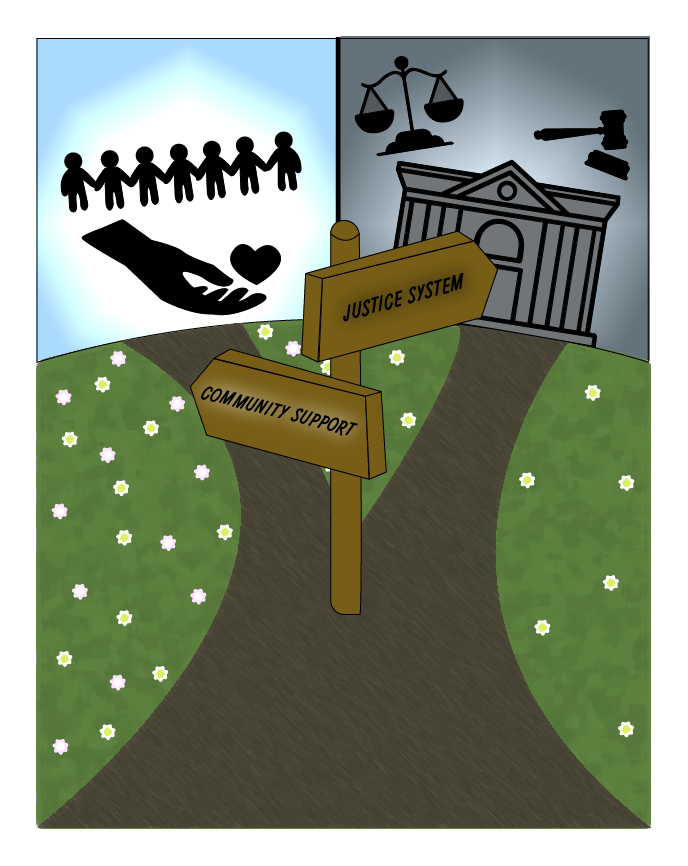
Currently, 30 out of 39 cities and towns in Rhode Island offer Juvenile Hearing Boards, an alternative to the juvenile justice system. Bernadette Tavares, the chair of the Providence Juvenile Hearing Board and Director of Careers at Foster Forward, and Luisa Sarante, Coordinator of the Providence Juvenile Hearing Board, explain how they actively engage with young first-time offenders so they can be reconciled for their past actions. Instead of going to youth detention centers, the youth have an option to gain leadership experience, serve their community, learn from their past actions, and grow from the experience.
Juvenile Hearing Boards: An Alternative to the Traditional Juvenile Justice System
February 2026 | Communities of Hope Civic Media, Solutions Journalism Network Student Media Challenge
By: Kate Tortolini, Macayla M. McDonald, and Rachel Fortuna Cabral
BRISTOL, RI | When young people in Rhode Island come into contact with the justice system, they may be offered an alternative path: juvenile hearing boards. These boards provide an opportunity for youth to receive community-based support, with a focus on preventing deeper involvement in the juvenile justice system.
According to the Rhode Island Department of Children, Youth, and Families, approximately 33% of youth in Rhode Island who enter the justice system recidivate within three years. “This process is really important because it allows our kids a second chance,” said Sarante.
In late 2025, nearly 32,000 youth were confined in United States juvenile facilities on any given day, according to Prison Policy Initiative. For minor offenses, punitive responses are often favored over positive rehabilitation programs. Incarceration is linked to severe mental health issues such as trauma, PTSD, depression, and high suicide risk. It also interrupts education, which limits academic achievement and creates barriers for developmental and employment milestones.
Early entry into the juvenile justice system can set youth on a trajectory toward deeper system involvement, underscoring the importance of rehabilitation and diversion programs. Their involvement in the system not only causes more trauma and damage to their mental health, but also results in extreme financial stress on states across the U.S.. According to a 2015 report by the Justice Policy Institute, the cost of incarceration varies from state to state, but averages $401 dollars per day and $146,302 per year in each states’ high-cost facilities. When taking length of stay into account, 34 states report spending $100,000 or more to incarcerate just one young person.
A study examining 73 diversion programs, which assessed 14,573 diverted youth and 18,840 youth processed through the traditional justice system, found that in 60 of the 73 programs, diverted youth had lower recidivism rates than their traditionally processed counterparts. Additionally, due to the high amount of juveniles in corrections facilities, there is a higher rate of abuse. According to a study conducted by the Justice Policy Institute in 2007, there were 13,000 allegations of abuse in facilities that housed 46,000 youth. This contributes to the mental health issues and trauma that many juveniles face. According to Rhode Island KIDS COUNT–a non-profit children’s policy and research organization that works to improve the health, safety, education, and economic security of children from birth through young adulthood–65% to 70% of juvenile offenders arrested nationally have a diagnosable mental health disorder. With the right support, these juveniles could avoid contact with the system all together.
Juvenile Hearing Boards
In communities across Rhode Island, Juvenile Hearing Boards are a growing alternative to the traditional juvenile justice system. The boards are a community-based approach to handling first-time offenders and certain misdemeanors. Some of the offenses that are eligible to get sent to a hearing board are things such as shoplifting, school fights, disorderly conduct, drug or alcohol charges, simple assault and weapon possession.
Each board opens up a conversation between themselves as a group, the youth, and the youth’s families to try to understand the context behind the offense. After a discussion with the youth about their morals, values, and interests, the hearing board attempts to provide a second chance for juvenile offenders.
How do these hearing boards work? Well, in Providence, if a young person is arrested, law enforcement can offer the alternative [JHB] to families. “Referrals go to the coordinator, often a member who works for the city,” explained Bernadette Tavares, the Chairwoman of the Providence Juvenile Hearing Boards.
After the referral is sent, if the youth and their guardians agree to the alternative, the youth is administered corrective sanctions, such as restitution for damages, community service, letters of apology, or counseling. Should they complete the JHB’s required sanctions, the offense will be forgiven.
Tavares described the role of both the young person and the board members: “After the police officer gives the report, we have the young person come in and give a recount of what led up to that situation,” she said. “After we get info from the report, we ask a series of questions to get a sense of what their strengths are, what challenges they might be experiencing, and how we can provide support or resources.”
Who Sits on the Boards
Luisa Sarante, the Coordinator of the Providence Juvenile Hearing Board, said that all board members must live in Providence, and be a part of the local community. The board makeup reflects that of the community. “That’s really important, because who is going to know the kids better than the people who grew up in the same situations, dealing with the same issues, and that have a better sense of understanding from a cultural perspective,” said Sarante.
She also explains the importance of community members in stepping up and wanting to be a part of the board. “It gives these kids exposure, letting them know: this is a black woman who is the director of et cetera, et cetera, at Providence College. This is a Hispanic woman who’s the dean of the college.” Sarante highlighted. “We like stuff like that that shows kids that there’s more out there.” By having these positive role models on the hearing board, youth are given a tangible example of what growth and accountability can lead to, demonstrating their own potential.
While the emphasis on community involvement is a clear strength of the boards, it can also create practical challenges. Because the boards are entirely volunteer-run, attendance can be inconsistent as board members balance personal and professional responsibilities. Recruiting volunteers also proves to be an ongoing challenge for multiple boards across the state for these same reasons.
Additionally, hearing boards vary widely between municipalities, as there is no statewide regulation or oversight. While this allows communities to tailor the hearing boards to the specific needs of their local youth, it also creates disparities in funding and capacity depending on the municipality.
Referral Process & Limitations
Despite the effectiveness of those serving on the hearing boards, shortcomings exist in how cases are referred to the boards. Referrals are the discretion of the police officer involved in the case with the juvenile. Tavares highlighted how this process of referrals impacts the youth: “If a police officer arrests a young person with a bad attitude that particular day, the police officer can choose not to offer this process to the family,” said Tavares. “There needs to be a legislative policy to ensure standards.”
In some cities with juvenile hearing boards, there are police chiefs that sit in on the hearing board. “Which to me is a complete conflict of interest,” Tavares explained. “There is trauma [Police Presence] attached to that for some kids.”
Kelsey Bala, senior policy associate at RI KIDS COUNT, and Jessica Vega, former chair of the Central Falls Juvenile Hearing Board and senior advocacy and community engagement manager at KIDS COUNT, emphasized that the program’s structure can restrict its reach. They echoed the sentiment of Tavares regarding how the arresting officer might not always refer a youth to a juvenile hearing board, which affects the process.
Vega explains that youth are only eligible to go before a hearing board once, limiting the boards’ ability to support youth who may need continued intervention. If a youth is rearrested during their time working with the hearing board, they are no longer allowed to continue on their restorative sanction.
Furthermore, some youth that go to juvenile hearing boards need counseling. However, counseling can only be recommended, not a required sanction required, due to financial constraints. Some JHBs ask the youth to have an evaluation or assessment, but not direct counseling.
Another issue is the limited amount of data available due to a lag in the collection. Since the police and family court are responsible for much of the data reporting, there is often a delay. Because of this, some cities reported that they were barely getting demographic information.
Juveniles will go back for a review, for the board to determine whether or not they have completed their sanctions, but there is no-follow up once a case is closed out. This also causes a lack in the proper data that is needed to analyze what the JHBs are doing right, and what could be done differently for an even greater benefit. Despite these challenges, the available data highlights the effectiveness of JHBs.
What the Data Shows
According to “The Relationship Between Juvenile Diversion Programs and Recidivism for Juvenile Offenders,” Jody L.E. Jacobsen found that existing research tends to support the effectiveness of diversion programs when compared to the regular court process.
“By reducing court time and using volunteers, diverting minor, first-time offenders out of the formal court process is cost effective.” Jacobsen wrote. “Diversion programs are also efficient because cases are not backed up on formal court dockets and thereby provide swift accountability and timely case resolutions. Many participants report high satisfaction rates and recidivism rates are often lower than traditional courts.”
According to the data that was reported from the RI Family Court on individual juvenile hearing boards: in 2022, out of the 391 cases heard by the JHB, only 42 were rearrested in that year, which is less than 10%. This indicates that the boards prepare youth for success following their involvement in the process.
The boards continue to work with the youth post completing the process. “We’ve connected kids with a lot of leadership programs, and what happens is that they stay [in the programs],” Sarante said. “Even after their sanction is done, and get a letter of completion, they are still enrolled.”
Alongside this, youth are given resources to help support them for potential future situations. “We provide tools to help them navigate these situations again,” said Tavares. “It offers them a chance to take accountability, but also gain the resources to move forward.”
A Holistic, Community-Centered Approach to Juvenile Justice
Juvenile hearing boards offer a glimpse into what a more humane, mental-health focused juvenile system could look like.
Additionally, community involvement reshapes traditional power dynamics within the justice system, reducing fear associated with authority. JHBs have demonstrated to juveniles that the community cares about them. Through this diversion program, the youth feel this care, and learn from the process.
Currently 31 out of the 39 cities in Rhode Island have juvenile hearing boards, but advocates hope that number grows. “The hearing boards deter young people from getting further involved with the juvenile justice system,”Vega says. “They provide them a chance to really explain what’s happening. The beauty of them is that they take a holistic view of the young person,” she added..
Contributers:
Research: Rachel Fortuna Cabral, Kayley Dias, Meghan Harvey, Macayla M. McDonald, Emma O’Neill, Kate Tortolini
Reporting: Rachel Fortuna Cabral, Joshua Geaughan, Macayla M. McDonald, Kate Tortolini
Writing: Rachel Fortuna Cabral, Macayla M. McDonald, Kate Tortolini
Editing: Rachel Fortuna Cabral, Macayla M. McDonald, Kate Tortolini
Managing Editor: Macayla M. McDonald
Investigative Editor: Rachel Fortuna Cabral
Graphic Design: Haylee Silva
Website Manager: Molly Stinchfield